
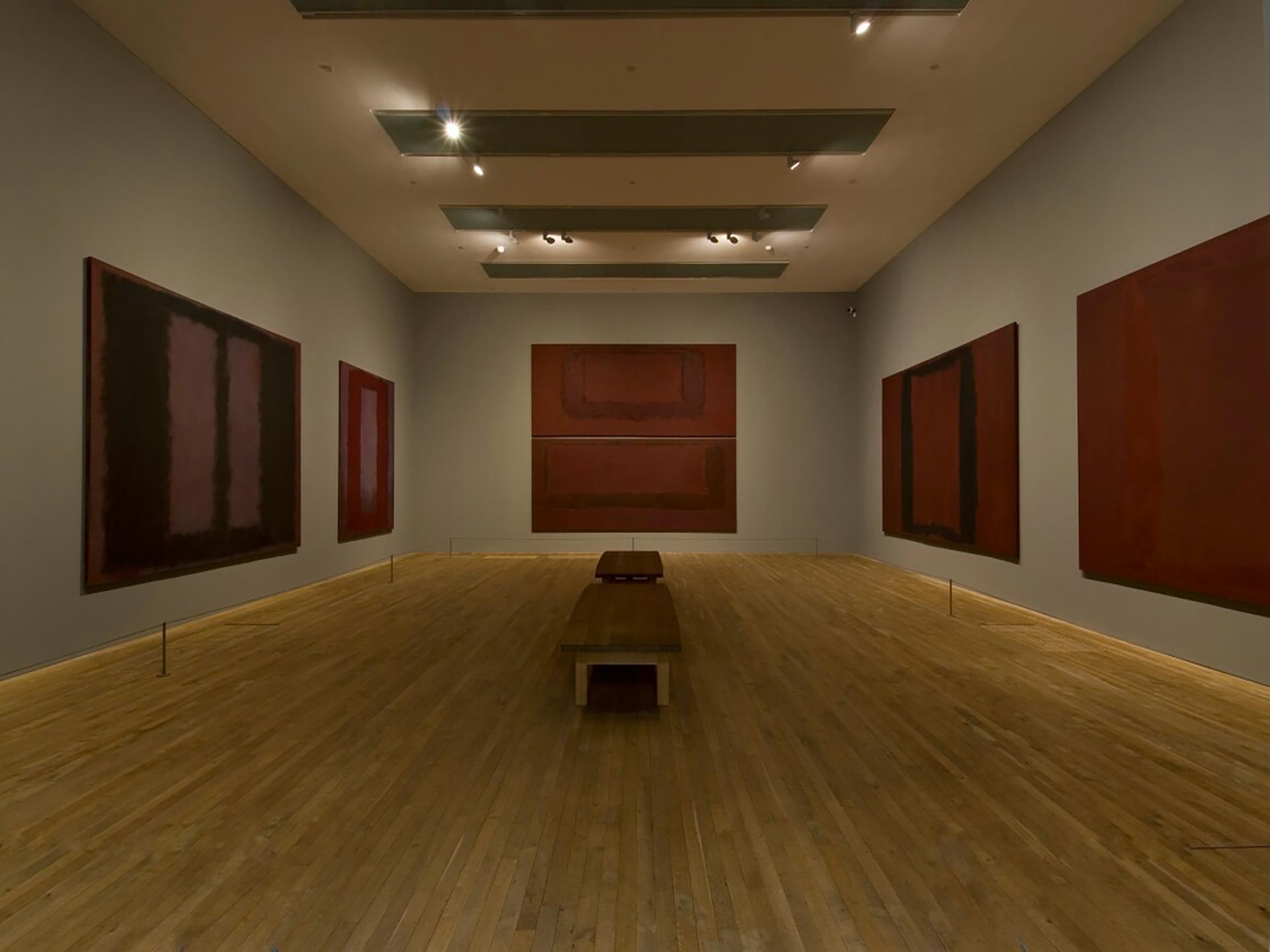

Mark Rothko |the Seagram Murals
One day I was in the Lenbachhaus, visiting an exhibition of 19th-century landscape paintings, which is a little unlike me as my tastes tend towards 20th Century Modernism but, nevertheless, the thought hit me: can or does art inspire awe in the same way as the natural world?
Psychologists Keltner and Haidt (2003) describe awe as a response to stimuli that feel “bigger than us,” something that challenges our mental frameworks and forces us to see the world differently. Nature delivers these moments in abundance: the infinite expanse of a night sky, a storm over a mountain range, the surging force of an ocean…in these encounters, we feel both small and connected, humbled yet exhilarated.
Art, though created rather than discovered, can hit us in a similar way
Vladimir Konečni (2005) talks about the “aesthetic trinity”: awe, being moved, and thrills. Paintings, sculptures, architecture, and music can overwhelm our senses, disrupt our usual thought patterns, and evoke deep emotional resonance. A soaring cathedral, a sprawling mural, or a powerful orchestral piece can make us feel both insignificant and part of something larger than ourselves. In that sense, art becomes a kind of “designed environment for awe,” deliberately crafted to move us, just as nature does spontaneously.
Of course, there’s a difference. Nature’s grandeur exists independently of us; art is intentional, mediated through culture, context, and human imagination. That intentionality doesn’t lessen the experience—it adds a layer of reflection. When we feel awe in front of art, we’re not just reacting to scale or beauty; we’re recognizing human creativity, expression, and the ability to evoke universal emotion.
evolutionary psychologists suggest that our brains are wired to respond to scale, complexity, and patterns—skills that helped our ancestors navigate the natural world (Shiota, Keltner, Mossman, (2007))
Now, I don’t have a PhD in psychology, but I would posit that art, in a sense, hijacks these mechanisms, offering a controlled, symbolic version of the awe we feel in nature. Both experiences invite us to pause, reflect, and confront something larger than ourselves. To refer to the image that I have chosen to illustrate this piece, I remember sitting in front of Rothko’s Seagram Murals and feeling that same quiet immensity—a kind of stillness that pulled me inward while expanding everything around me. It wasn’t beauty in the decorative sense, but something deeper: an encounter with the sublime, distilled into colour and light. So, perhaps, awe may be one of the bridges between nature and art. Both remind us of the vastness of existence and the capacity of the human mind to perceive, reflect, and feel deeply. If art’s purpose is to inspire wonder and reflection, it succeeds by creating spaces where awe can flourish—reminding us of that world outside the window.
References:
Keltner, D., & Haidt, J. (2003). Approaching awe, a moral, spiritual, and aesthetic emotion. Cognition and Emotion, 17(2), 297–314.
Konečni, V. J. (2005). The aesthetic trinity: Awe, being moved, thrills. Bulletin of Psychology and the Arts, 5, 27–44.
Shiota, M. N., Keltner, D., & Mossman, A. (2007). “The nature of awe: Elicitors, appraisals, and effects on self-concept.” Cognition and Emotion, 21(5), 944–963.